
The I-RIM 3D 2026 demos will offer visitors the opportunity to see and experience first-hand some of the latest technologies in robotics and intelligent machines. The programme features eight demos proposed by universities and research centres, presenting innovative solutions through live demonstrations.
The demos will take place in the gazebo in front of Building F (Area A of Maker Faire), organized as follows:
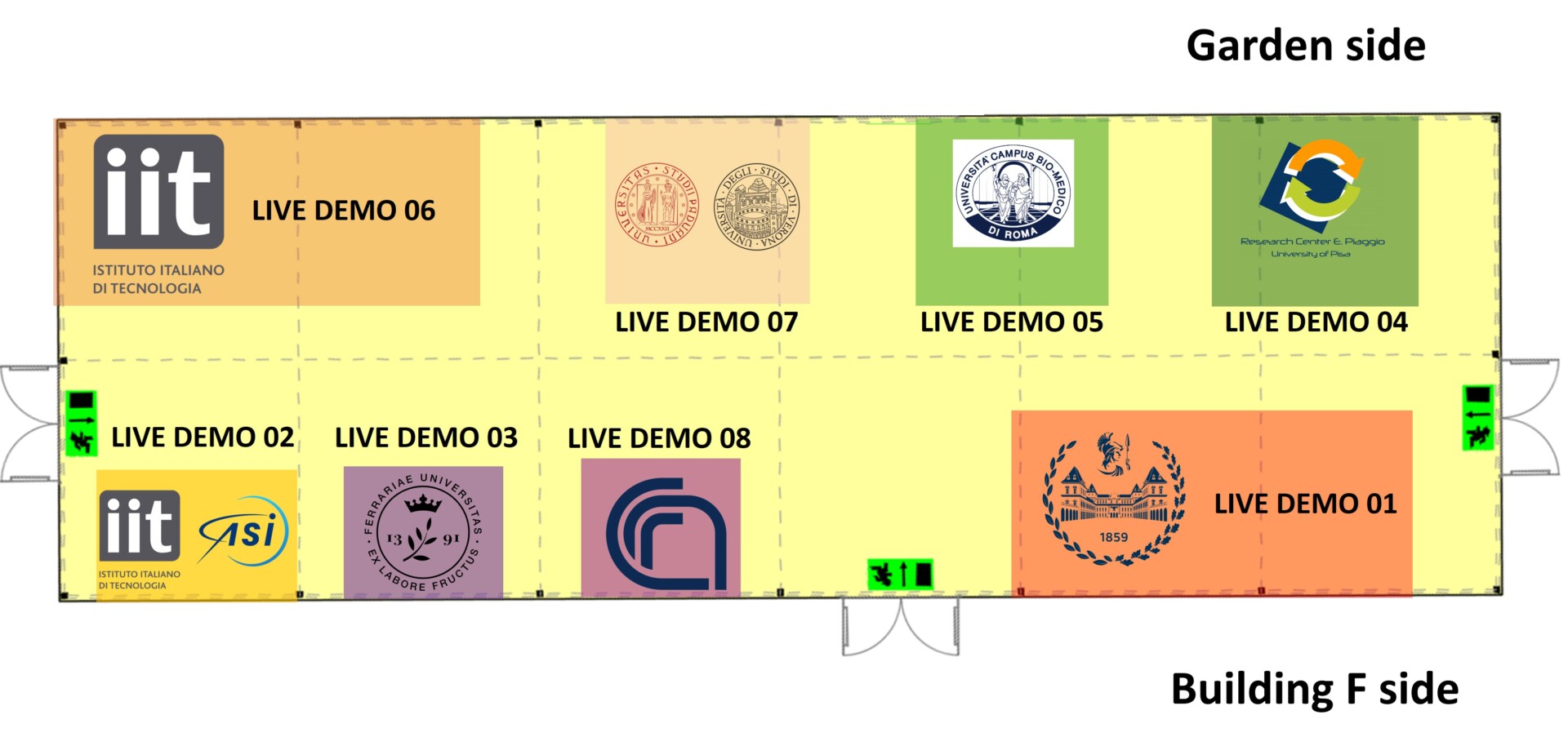
LIVE DEMO 01
ADD-MATE – An Intuitive and Adaptive Assistive Device for Manual Wheelchair Mobility
Valerio Cornagliotto, Michele Polito, Stefano Pastorelli
Politecnico di Torino
ADD-MATE is a power-assistance device for manual wheelchairs that interprets the user’s motion intention and provides support during propulsion and manoeuvring. During the demo, visitors will be able to directly experience the difference between navigating with and without assistance.
LIVE DEMO 02
ROSAIA: Vision-Guided Shape Control of a Four-Arm Continuum Robot for Soft-Touch Interaction
Albin Bajrami, Marcel Gabriel Lahoud, Nahuel Jose, Yasir Mehmood, Lorenzo D’Acierno, Farshad Nozad Heravi, Gabriele Marchello, Orietta Lanciano, Agustina Scaro, Ferdinando Cannella
Italian Institute of Technology (IIT) / Italian Space Agency (ASI)
ROSAIA is a four-arm tendon-driven continuum robot developed for soft contact and grasping. Through a human-machine interface, visitors can select different robot configurations, which are executed using an AI-based vision and control system.
LIVE DEMO 03
AUROVAS – Autonomous Robotic System for Vascular Ultrasound Screening
Saverio Farsoni, Jacopo Rizzi, Andrea D’Antona, Marco Roma, Marcello Bonfè, Giulia Baldazzi, Anselmo Pagani, Paolo Zamboni, Alessandro Bertagnon
University of Ferrara
AUROVAS is an autonomous robotic system for vascular ultrasound examinations. A collaborative robot equipped with a clinical ultrasound probe operates on a realistic anatomical phantom, combining AI-based image analysis, autonomous motion planning, and force-controlled manipulation. The demo showcases the application of these technologies to different vascular screening procedures.
LIVE DEMO 04
Nino: A Social Media Robot for Public Engagement
Francesco Iotti, Michele Lisi, Yuri De Santis, Franco Angelini, Manolo Garabin
Piaggio Research Center, University of Pisa
Nino is a mobile social robot designed to interact with visitors in public and educational environments. During the demo, it will move through the exhibition space and engage visitors in short conversational interviews about robotics and human-robot interaction, combining navigation, perception and interaction capabilities.
LIVE DEMO 05
Tele–Arm Wrestling: An Interactive Human–Robot Challenge through Real-Time Tele-Impedance Control
Salvatore Maria Li Gioi, Francesco Cocco
Università Campus Bio-Medico di Roma
An interactive robot-mediated arm-wrestling challenge allows visitors to directly experience teleoperation and impedance control. The robot’s motion and stiffness are modulated in real time according to the teleoperator’s movements and muscle activity, creating a direct physical interaction between human and robot.
LIVE DEMO 06
Quadruped Robots in Action: from Teleoperation to Natural Language Interaction
Victor Barasuol, Giulio Turrisi, Yonas Tefera, Marco Carega, Valerio Belli, Giovanni Minelli, Antonio Langella, Claudio Semini
Italian Institute of Technology (IIT)
Two quadruped robots showcase different interaction and control approaches, from VR-based teleoperation of a quadruped equipped with a manipulator to natural-language interaction with an AI-assisted robot. The demo also presents robust locomotion strategies that allow the robot to adapt even when one or more legs lose functionality.
LIVE DEMO 07
A Torque-Controlled Semi-Active Exoskeleton for Adaptive Gravity Compensation: Wearable and Benchtop Demonstrations
Francesco Pascucci, Eldison Dimo, Mario Sedilesu, Elia Tonoli, Andrea Montanari, Andrea Calanca
University of Verona / University of Padua
The demo presents a semi-active adaptive gravity-compensation system through two interactive setups: a benchtop prototype and a wearable shoulder exoskeleton. Visitors can interact with both systems and directly experience how assistance adapts to changes in load and body posture.
LIVE DEMO 08
Collaborating with a Service Robot – Demonstrating Prosocial Behaviors in Human-Robot Collaboration
Elisa Foderaro, Christian Tamantini, Alessandro Umbrico, Andrea Orlandini
National Research Council of Italy (CNR-ISTC), Rome
This demo explores the role of social behaviours in human-robot collaboration. The TIAGo service robot collaborates with visitors in a simple manipulation task, using gaze behaviours and short context-aware messages generated by a locally hosted language model to support the different stages of the interaction.